Stinging wasps and hornets confront you on your own property with the threat of painful attacks and potential allergic reactions. Take your home and yard back with Colonial Pest Control’s effective wasp and hornet removal. We have been safeguarding homes in Massachusetts and New Hampshire since 1984 with swift and effective wasp extermination, hornet removal, and bee control services. Don’t wait to get stung – set up a visit now!
Paper wasps, yellow jackets, bald-faced hornets, bees, and other flying, stinging insects must be dealt with by a reliable company with trusted experience who stands by their work. Our professional service technicians are trained and licensed to safely deliver pest control solutions to eliminate the wasp nest and apply long-lasting residual insecticides to prevent rebuilding. We do this while using the latest in technology and methods to target the stinging insects where they nest and protect beneficial pollinators and the environment.
Target the Nest – Remove the Pest
Each type of nest indicates a different type of stinging pest. Our expert technicians will identify the species and provide the best solution based on the nest type, location, and specific type of stinging insect to not only treat and remove the present pest threat, but provide lasting protection to prevent pest problems for the wasp and hornet season.
Umbrella Nest – Paper Wasps
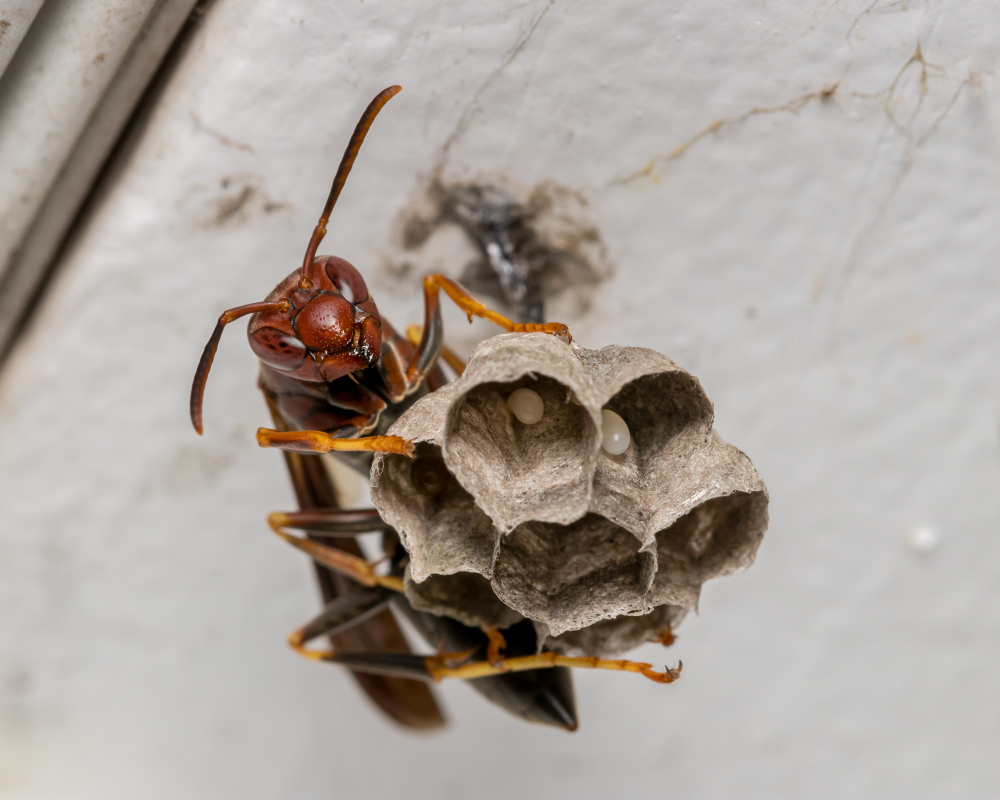
Umbrella wasp nests are open-air structures, lacking a protective envelope. The cells are exposed, facing downward for eggs and larvae. They can be compact walnut-sized nests, and they grow throughout the season. Common places to find umbrella nests are in sheltered spots such as hanging under soffits, within fence posts, behind shutters, and under seasonal furniture including your sun umbrella.
Paper wasps are the primary semi-social occupants of these nests. These include the native Northern paper wasp (Polistes fuscatus) with its reddish-brown body and yellow markings, and the black and yellow striped invasive wasp often confused with Yellowjackets, the European paper wasp (Polistes dominula). About half of the individuals in a nest are female; each female paper wasp can become queen of her own nest. They size about .75-1” and have a narrow waist and dangling legs when in flight.
Paper wasps prey on garden pests like caterpillars. They are active from March through October, and their life cycles take between 28-48 days to complete the egg-to-adult process. Paper wasps are not as aggressive as Yellowjackets and hornets, but they will sting if their territory is threatened or they are provoked. Often, the stings come after an accidental encounter like grabbing the deck railing with a hidden nest underneath, removing the shutter for cleaning, or setting up the patio furniture without realizing the wasps were already considering it home.
Void Nest – Yellow Jackets
Certain wasps will take advantage of an existing void or cavity to build a nest. This can occur in the ground, often taking over a ground squirrel or snake tunnel. Commonly, these void nests are found in wall or ceiling voids or even in the bays of a basement sill space. Wasps enter through small openings, leading to empty void spaces where they can build impressive nests discreetly. A void nest, whether ground or structural void, can build quickly without being detected unless an unfortunate encounter reveals the site. The black and yellow striped wasps size about .5-.75” and have a short but narrow waist.
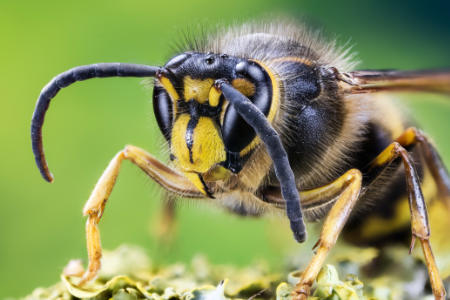
Yellow jackets (Vespula spp.) are the likely culprits responsible for void nests. Paper wasps can seem to nest inside of voids, but are usually using an entrance to build an umbrella nest in a protected space near the opening, such as an attic gable vent or under fascia trim boards of your home’s siding. Yellowjackets are a social insect, expanding their nest from the first brood in late spring to 3,000-5,000, sometimes up to15,000 individuals by the end of the summer. The life cycle is typically 3-5 weeks, egg to adult.
Yellow jackets feed on a variety of foods, including scavenging for sweets and proteins, and by hunting other insects. These wasps are considered aggressive and territorial anywhere near their nest. They often crash backyard cookouts as well, being drawn to the aroma of the grill and other foods and drinks. Hummingbird feeders are also attractive to these and other wasps. We often get calls when someone is stung when they accidentally disturb a nest by closing a door and rattling the void nest, mowing the lawn and vibrating the nest beneath the soil, or when the nest breaks through an inside wall and creates havoc inside your home.
Another notable species found nesting in voids is the only true hornet endemic in New England, the European Hornet (Vespa crabro). This giant hornet measures up to 1.5” and closely resembles a large yellow jacket, though there are a few other physical distinctions. The thorax and wings appear a bit more reddish-brown, it has a hairy head, and the yellow and brown stripes on the abdomen set it apart from the smaller yellow jackets. Nests are found in structural voids, attics, sheds, and hollow trees. Colonies range between 200-1,000 workers. Adults often feed on sugars from fallen fruit and are nocturnal foragers.
Exposed Carton “Ball” Nest – Bald Faced Hornet & Yellowjackets
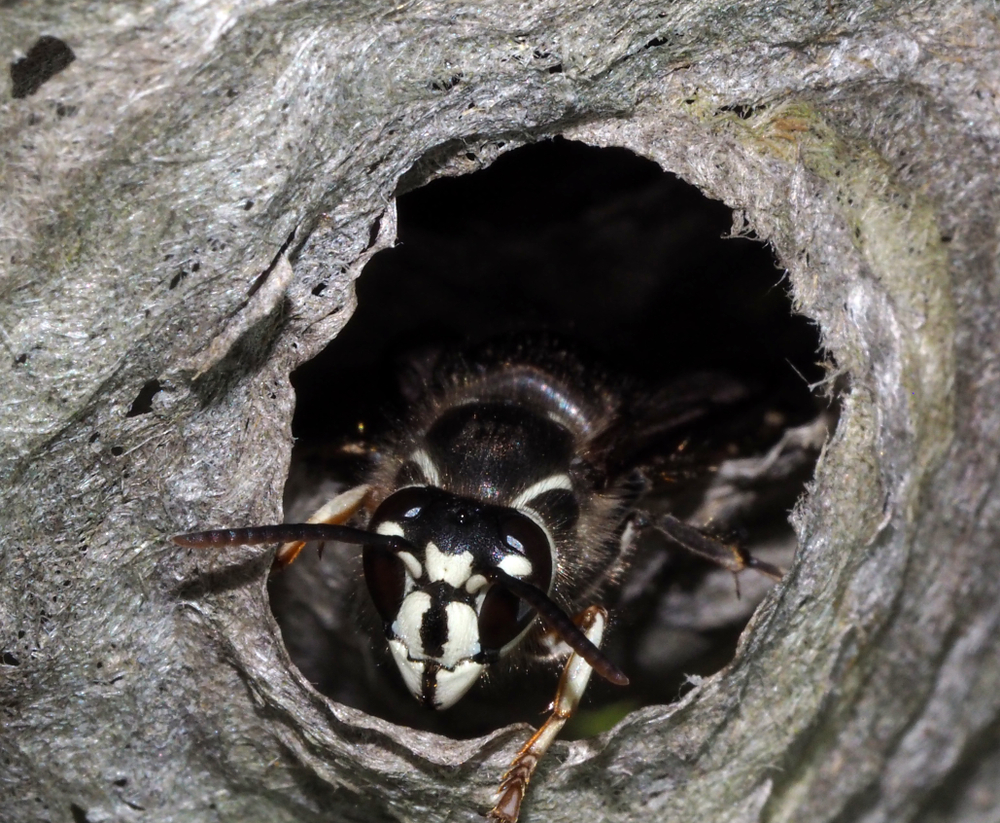
A carton nest is a covered or domed nest, often ball-shaped, with an entry/exit hole located near the bottom. We call this opening the “window.” Inside the nest are stacks of combs containing cells, protected by the cardboard-like outer case. The shape and size of these nests are often compared to balls of different sports or to round fruits. The nest starts with one tier of combs surrounded by a golf-ball-sized carton. Then, it grows to baseball, softball, football, and basketball-size nests. As the season extends into September and October, we start counting exactly how many basketballs or footballs the nest resembles!
Various yellow jacket species and bald-faced hornets, also known as white-faced hornets, are the creators and protectors of these nests. Dolichovespula species are particular to building these exposed, paper carton nests hanging from under soffits, on protected sides of structures, and in bushes and trees. Bald-faced hornets are slightly larger than most yellow jackets, sizing .5-.75” or up to 1” for some members of the colony with narrow waists and large, wide bodies. Black and yellowish-white stripes and distinctive markings on their heads and faces are distinctive markings for these wasps.
Aerial nest-dwelling wasps such as aerial yellow jackets and bald-faced hornets are notably aggressive. Their protective nature extends beyond what we would consider their territory surrounding their nest to include food sources, flight paths, and other excuses to sting. They rarely are aggressive while foraging, but any disturbance to their nest is likely to result in an attack. As the season winds down in the fall and natural food becomes scarce, these wasps are less predictable and fly lower to the ground to scavenge for food.
Other Bees and Wasps
Not every buzz is a sting threat. In New England, we host a number of native and non-native bee and wasp species. These insects share standing in the Order Hymenoptera with ants and sawflies. Females in this Order have a stinger, which is an ovipositor originally used for laying eggs, but which has developed into a weapon for defense. Many bees and wasps are more beneficial than a threat, and our technicians know the difference.
The Difference between Bees and Wasps
Bees and wasps are similar in many ways as members of the same Hymenoptera Order, but they differ in some important ways related to diet, behavior, appearance, and ecology. Bees are key pollinators, feeding almost exclusively on pollen and nectar for their protein and carbohydrates. Wasps are carnivorous omnivores. Bees typically have a robust and hairy body, while wasps tend to be smoother with a more narrow waist, shinier appearance, and more slender body. Bees are generally less aggressive and sting in defense, with honey bees dying after stinging. Bees also build wax combs while wasps rely on paper production for their nests.
European Honey Bees are beneficial pollinators which can occasionally become a pest based on where they choose to nest. In a wall void in your home, we recommend contacting a local apiary (beekeeper) to remove the nest and honey. In case the apiarist declines removal, we can treat and recommend removal of the old nest before it develops secondary pest problems.
Carpenter Bees are pollinators, but are also structural pests. These large bees drill holes to create galleries, provisioning eggs with pollen and nectar for their young to consume before they emerge. The process continues until they either destroy wood on your home, or you engage Colonial Pest to solve the problem.
Cicada Killer Wasp can be scary; its adults come in around 2” and dig holes into sandy soil, dragging paralyzed cicadas into their subterranean lairs. They are rarely aggressive towards humans but can cause quite a disturbance. Most of their holes can be treated by Colonial Pest with preventative advice shared to prevent further invasions. Some infestations require lawn service to complete the remediation.
In addition to these bee and wasp species in Massachusetts and New Hampshire, beneficial pollinating ground bees, mason bees, and mason wasps serve their roles well in our ecosystem. At Colonial Pest Control, we can discern the beneficial pollinators from the aggressive stinging types and partner with you to plan for each.
Our process includes the swift removal of harmful wasp nests and the application of insecticides to prevent them from rebuilding. We back our work with our proven commitment to our community and an industry-leading warranty and satisfaction guarantee.
100%SatisfactionGuarantee
Colonial Pest Control offers a 100% Satisfaction Guarantee:
If you’re not completely happy with our service, we’ll make it right.
Bees are fuzzy with stout bodies and pollen-carrying legs — they are vital pollinators primarily feeding on pollen and nectar. Wasps have a narrow “wasp waist,” smoother shiny bodies, and bright yellow-and-black or brown markings, feasting on meat and insects as well as plant matter and trash. Hornets endemic in New England are the European Hornets, which are large and similar to yellow jackets’ markings. These often scavenge at night and nest inside of voids.
Common home invaders in MA and NH include paper wasps (open umbrella nests under eaves), yellow jackets (ground or wall voids), and bald-faced hornets (large enclosed gray paper nests in trees or shrubs). A well-trained Colonial Pest technician can help nail down the proper identification.
Paper wasps build small, open-comb “umbrella” nests under eaves, decks, and railings. Yellowjackets often nest underground or in wall voids and become aggressive scavengers in late summer. Bald-faced hornets construct large, enclosed gray paper nests high in trees or shrubs.
Early identification helps determine the safest removal approach.
Remove nests located near doorways, patios, children’s play areas, or high-traffic zones where stings are likely. Nests far from activity (deep in trees or shrubs) can often be left alone because these insects prey on garden pests like caterpillars.
If anyone in the household has a stinging-insect allergy, professional evaluation is strongly recommended.
Early spring, when nests are small with only a few wasps, is the easiest and safest time. Late summer and early fall bring peak colony size and aggression. Treating at dawn, dusk, or cool days provides a more sluggish nest with individuals inside the nest, but professional treatment provides lasting residual controls at any time.
DIY sprays carry real risk of multiple stings, incomplete colony elimination, and allergic reactions. Enclosed nests (yellow jackets or hornets) are especially difficult and dangerous to handle without proper gear and training. Void nests often return without professional materials and methods.
Technicians inspect first to identify species and nest location, then apply targeted dusts or treatments directly into the nest during low-activity hours. The colony is eliminated, and the nest structure is often removed to prevent staining or secondary issues.
This approach minimizes impact on beneficial insects when performed by experienced local providers.
Seal cracks, gaps, and vents in early spring before queens begin building. Keep outdoor trash covered, clean up food and drink spills promptly, and trim vegetation away from structures.
Removing old nests during winter and scheduling professional exclusion services provides the most reliable long-term protection for upscale properties.
Many wasps and hornets are helpful predators that hunt caterpillars, aphids, and other garden pests, reducing the need for other controls. While they visit some flowers, bees remain the primary pollinators.
Non-threatening nests away from people support natural pest control and ecosystem balance.
We understand the importance of acting quick to remove aggressive wasp nests. While the scheduling may vary, we make every effort to remove these wasps nests as quickly as possible. Our goal is to get the work completed within a few days in most cases, but we do prioritize nests that may cause more immediate harm with even quicker response.
Nests that build in wall/ceiling voids and breach into living spaces, nests near children’s playlets, and similar situations are scheduled next day as much as possible.
Colonial Pest technicians prioritize the health and safety of your family and pets. We use the latest in technology and methods to directly target the nest and apply residual pesticides where they will make the most impact without harming your family. In sensitive areas, we will target and remove the nest, leaving no trace of us behind.
Only remove nests that pose a genuine safety risk rather than eliminating every insect. Professionals use targeted nest treatments at times when pollinators are less active and avoid spraying flowers.
Honey bee colonies (fuzzy, in hives or wall cavities) should be relocated live by a beekeeper whenever possible instead of being exterminated.
Have any nearby nests professionally assessed and removed promptly. Keep an epinephrine auto-injector accessible and consult your allergist for personalized advice.
Increased late-season activity is normal but warrants inspection if nests are close to living or play areas.
Wasps, hornets, and bees are beneficial insects in many respects. Bees are primary pollinators and are protected whenever possible. Wasps and hornet contribute to pollination as well, but their primary benefit is due to their removal of caterpillars and similar insects that may cause to your plants.
While they are working, bees, wasp, and hornets are not typically aggressive and pose no hard to you in the garden. They become aggressive when they are near the nest they are protecting, or if they are directly threatened – or accidentally confronted!
The best thing for you to do while waiting for a technician to come out is to keep your loved ones away from the nest. Mowing, construction, or children running around may cause troublesome vibration that cause wasps to become aggressive. Until we arrive, if you leave the wasps’ territory alone, they should leave you alone.
If the nest is in the ground or may be difficult to find, placing a marker or a sign in the area would be helpful for our technicians.
Customer Reviews
Read stories of impact, share your own experiences, and celebrate the connections that make us stronger.
Have a question or dealing with a pest issue? Fill out the form below and we’ll be in touch soon. There’s no obligation and no pressure, just honest answers from a local team that’s happy to help.