If you’ve discovered tiny round holes in hardwood floors, fine powdery dust on basement or crawlspace floors, or larger oval holes in structural timbers, you may be facing powder post beetles or other wood-boring insects. These pests can silently damage beautiful hardwood flooring, trim, furniture, and even structural softwoods in New England homes.
At Colonial Pest Control, trusted by homeowners across MA and NH since 1984, we deliver expert identification, precise diagnosis of active versus old damage, and safe, long-lasting treatments that protect your family and your home’s value.
Understanding the Common Powder Post Beetles (The “Big Three”)
Three primary beetle families are commonly grouped as powder post beetles (PPB). Each has distinct preferences, damage signatures, and re-infestation risks:
True Powderpost Beetles (Lyctidae)
Attack only hardwoods with large pores and high starch content — oak, ash, hickory, maple, walnut, and some tropical hardwoods or bamboo. Common in premium hardwood flooring, cabinets, trim, and furniture.
- Damage: Larvae reduce wood to a fine, talcum-powder-like frass that sifts out in small piles. Adults leave pinhead-sized round exit holes (≈1/32″–1/16″).
- Lifecycle: Typically 9–12 months (can be as short as 3 months or up to 2+ years).
- Re-infestation likelihood: Moderate to high on unfinished or porous wood while starch remains accessible. Finished/sealed surfaces greatly reduce risk.
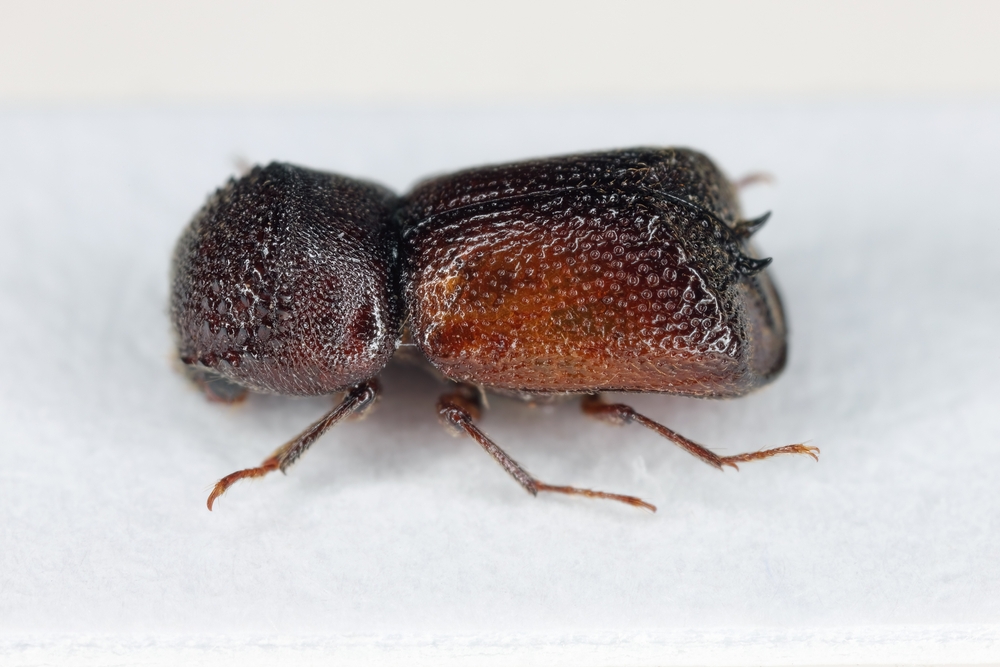
False Powderpost Beetles (Bostrichidae)
Attack sapwood of hardwoods (and some softwoods), often in recently processed or imported lumber and furniture.
- Damage: Coarser, mealy frass that tends to pack in galleries. Exit holes larger (≈1/8″–1/4″).
- Lifecycle: Usually about 1 year.
- Re-infestation likelihood: Lower in dry, seasoned, finished wood; more common in new or improperly stored lumber.
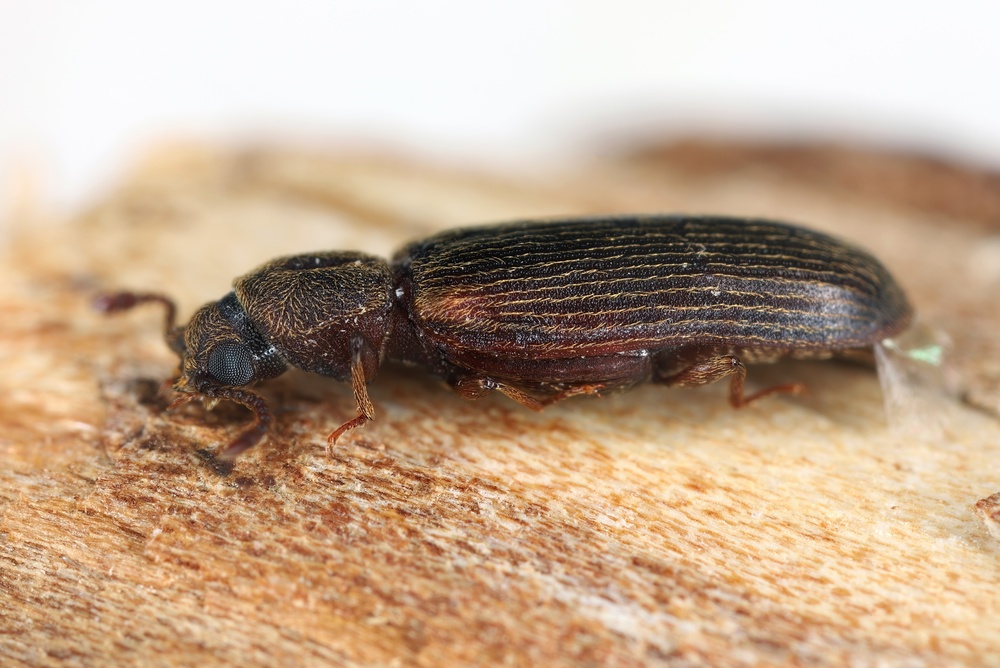
Anobiid / Furniture / Deathwatch Beetles (Anobiidae)
Primarily attack softwoods (pine, fir, spruce) but can infest some hardwoods. Often found in structural elements like floor joists, studs, beams, and subflooring in damp crawlspaces, basements, or attics — very relevant in older MA and NH homes.
- Damage: Fine powdery frass that may feel gritty (contains lemon-shaped pellets). Exit holes slightly larger round holes (≈1/16″–1/8″).
- Lifecycle: 1–3+ years, often longer in cooler or drier conditions.
- Re-infestation likelihood: Higher in persistently moist structural wood; can persist year after year if humidity stays elevated.
Old House Borer (Hylotrupes bajulus) — A Distinct Structural Threat
Often confused with powder post beetles, the old house borer is a longhorn beetle that targets **softwoods** (pine, spruce, fir sapwood) used in framing, joists, and beams. It is more common in the eastern U.S., including New England, and frequently appears in homes built or renovated with infested lumber within the last 10–20 years.
- Damage: Large oval exit holes (≈1/4″–3/8″), coarse frass containing tiny barrel-shaped pellets, and rippled galleries. Larvae can significantly weaken structural members over time, especially in damp areas. You may hear rasping sounds from mature larvae.
- Lifecycle: 3–6 years on average (range 2–15 years). Optimal in wood with 15–25% moisture content; development stops below ~10%.
- Re-infestation likelihood: Can re-infest if moisture levels remain suitable; adults emerge in spring/summer and seek nearby exposed softwood.