Carpenter Bee Control & Extermination in Massachusetts & New Hampshire
Large black bees drilling perfect round holes into your deck, fascia boards, eaves, or trim? Those are carpenter bees, and while they may look intimidating, the real issue is the hidden damage they cause — and the woodpeckers they attract.
At Colonial Pest Control, we deliver expert carpenter bee control and carpenter bee extermination services across Massachusetts and New Hampshire. Since 1984, New England homeowners have trusted our founder-owned team to eliminate active nests safely and prevent future problems before they damage your home’s value or appearance.
Is It a Carpenter Bee or a Bumble Bee?
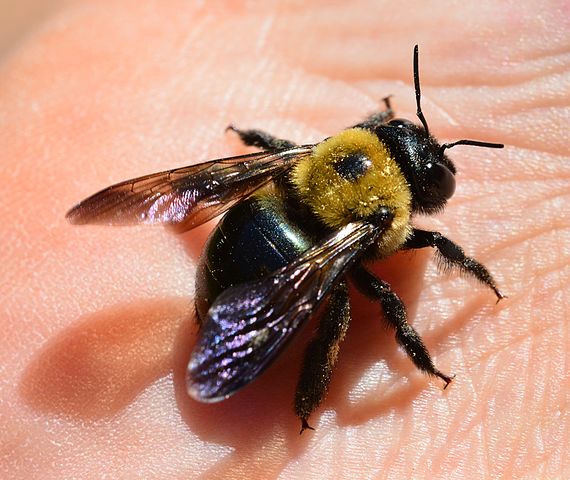
Carpenter bees have a shiny, hairless black abdomen. Bumble bees are fuzzy all over and live in underground colonies. Carpenter bees are solitary — they nest in pairs in wood. The males hover aggressively near the entrance to guard the nest (but they cannot sting). The females are busy and rarely aggressive.
Signs of Carpenter Bee Activity on Your MA or NH Home
Perfectly round ½-inch holes in bare, weathered, or unpainted wood (decks, railings, fascia, eaves, window sills, fences)
Fine sawdust piles directly below the holes
Yellow-brown fecal stains running down siding or trim
Large bees hovering or dive-bombing near the same spot every spring
Woodpecker pecking damage — birds tear into the wood to reach the larvae inside
Why Carpenter Bees Can Become a Real Problem
Carpenter bees are beneficial pollinators and their nesting activity usually lasts only about a week in spring. However, they prefer soft or untreated wood and often return to the same sites year after year. Over time, the galleries (tunnels 4–6 inches long inside the wood) can weaken trim and structural elements. Their excrement stains siding, and exposed holes allow moisture to enter, leading to rot.
The bigger issue? Woodpeckers. Once larvae are inside the galleries, woodpeckers peck large, unsightly holes to reach them — often causing far more damage than the bees themselves. For homeowners who have invested in beautiful decks, porches, and well-maintained homes, this is unacceptable.
Why Professional Carpenter Bee Control Beats DIY
Store-bought sprays and plugs rarely reach the larvae deep inside the galleries or stop new bees from nesting nearby. The problem returns the following spring. Our targeted, professional approach eliminates the current infestation and creates a long-lasting deterrent.
Our Proven Carpenter Bee Removal Process
We follow a thorough, science-based method refined over four decades serving Massachusetts and New Hampshire homeowners:
Comprehensive Inspection— Our state-certified technicians inspect all potential nesting sites on your home, deck, outbuildings, and trim to locate every active gallery.
Elimination of Active Bees & Larvae — We apply a specialized insecticidal dust directly into the nesting galleries. This reaches adult bees, eggs, and developing larvae inside the wood for complete clean-out of the current infestation.
Preventative Residual Treatment — We treat surrounding and susceptible wood surfaces with a long-lasting deterrent. New carpenter bees that land on treated areas are repelled and cannot bore new nests.
Exclusion Recommendations — After treatment, we advise sealing the holes and painting or staining bare wood to discourage future nesting. In severe or recurring cases, we discuss integrated options such as replacing damaged trim with synthetic materials.
Preventative Maintenance Program Enrollment — The best long-term solution is ongoing protection. After the initial service eliminates the immediate problem, our seasonal preventative programs keep carpenter bees from returning year after year.
Why Homeowners Choose Colonial Pest Control for Carpenter Bee Control in MA & NH
Trusted Since 1984 — Over 40 years protecting New England homes with reliable, high-quality service.
100% Satisfaction Guarantee — If carpenter bees return after our initial treatment, we return at no additional cost.
Local Expertise — Founder-owned and operated with deep knowledge of Massachusetts and New Hampshire wood structures, climate, and pest behavior. Two on-staff entomologists support our team.
Safe & Responsible — We prioritize low-impact, low-toxicity products that protect your family, pets, and the environment while delivering results.
Custom Plans — Every home is different. We tailor treatment and prevention to your specific property and needs.
Protect Your Home with the Right Carpenter Bee Solution
Preventative maintenance is the smartest long-term strategy. The most effective approach starts with a professional initial service that includes thorough clean-out of the current problem plus immediate preventative treatment — then continues with our ongoing programs for complete peace of mind.
Don’t wait for woodpecker damage or recurring holes to appear. Get ahead of carpenter bees this season.
Carpenter bees are large (¾–1 inch long) with a fuzzy yellow thorax and a shiny, hairless black abdomen that gives them a metallic appearance. They are often confused with bumblebees, but bumblebees have hairy abdomens. Males frequently hover near wooden structures but cannot sting.
Look for perfectly round ½-inch holes in bare, weathered, or unpainted wood such as eaves, decks, railings, fascia, and siding. Fresh piles of coarse sawdust (frass) beneath the holes and active bees flying nearby in spring are clear signs of an infestation.
Carpenter bees excavate tunnels for nesting rather than consuming wood. A small number of holes is mostly cosmetic, but repeated or multi-year activity can weaken structural wood, allow moisture entry, and attract woodpeckers—potentially affecting your home’s appearance and long-term value.
Yes. Carpenter bees are widespread across New England and particularly active around wooden homes from April through June when females begin excavating new nests.
The most reliable method is to apply a targeted insecticide dust or foam directly into active nest holes in the evening, allow returning bees to contact the treatment for a few days, then seal the holes with caulk or wood filler. Painting or staining exposed wood provides the best long-term prevention.
Professional dust or aerosol applications reach deep into galleries to eliminate bees and larvae. After treatment, holes must be properly sealed. DIY sprays or essential oils often provide only temporary relief and fail to address eggs or hidden tunnels.
Traps can reduce adult populations and offer supplemental control when placed near active areas. However, they rarely solve an established infestation on their own and are most effective when combined with direct nest treatment and preventive maintenance.
Early to mid-spring (April–May) is ideal, before tunnels are fully developed and eggs are laid. Treating during peak activity gives the highest success rate; late-season treatments are far less effective.
For safety, reach, and complete results—especially on high eaves or with multiple holes—professional treatment is strongly recommended. Colonial Pest Control technicians use targeted, labeled products and proper techniques to protect your home while minimizing disruption.
Carpenter bees are not aggressive and do not pose a significant threat. They are beneficial pollinators and do not transmit diseases. They focus on nesting rather than interacting with humans or pets.
Only females can sting, and they do so only if directly handled or severely provoked. The males you often see hovering nearby cannot sting at all and are harmless despite their territorial behavior.
Yes. When applied by trained technicians according to label directions, modern treatments have low toxicity once dry. Our team uses precise applications and provides clear re-entry guidance to keep your household safe.
Paint or stain all exposed wooden surfaces—carpenter bees strongly prefer untreated, weathered wood. Seal holes after treatment and schedule an early-spring professional inspection to catch new activity before it becomes established.
Yes. They are valuable pollinators for gardens and native plants. While we manage them around structures to protect your home, they play a positive role in the ecosystem when nesting in natural dead wood away from buildings.
Customer Reviews
Read stories of impact, share your own experiences, and celebrate the connections that make us stronger.
Have a question or dealing with a pest issue? Fill out the form below and we’ll be in touch soon. There’s no obligation and no pressure, just honest answers from a local team that’s happy to help.