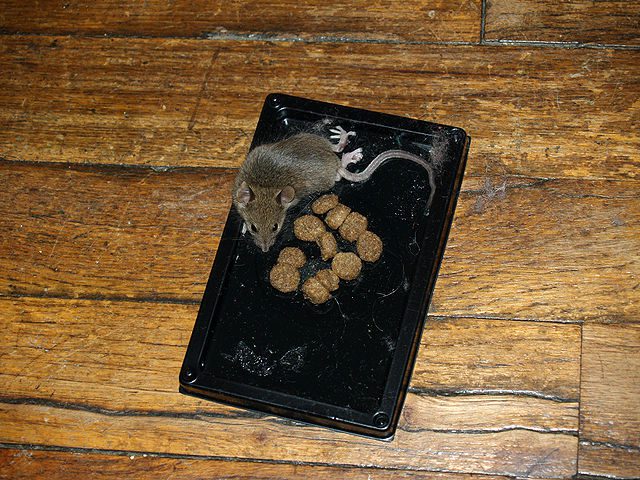
Customers often ask us about the use of glue traps, also known as sticky traps, for mice. A glue trap is a small cardboard or plastic tray with a very sticky surface that catches and holds mice that touch the glue. Just like the alternative snap traps, glue traps have certain advantages and disadvantages.
Reasons Why Glue Traps Are a Good Idea
- Glue traps are nontoxic, no poison baits involved
- Glue traps are cheaper than snap traps, but unlike snap traps are only good for one use (or one mouse)
- Glue traps (like snap traps) hold the dead mouse so there are no worries about mice dying and smelling in hidden places
- You can easily dispose of the dead mouse and trap together, just wrap them and put them in the garbage
- You don’t have to clean and re-set and re-bait glue traps
- You can usually cut or fold the traps to fit into tight places
Reasons Why You Might Not Want to Use Glue Traps
- Mice don’t usually die quickly or quietly, but struggle and suffocate
- Trapped and dead mice are usually very visible on a glue trap (but you can place the trap inside a covered station)
- Children and pets can get stuck on glue traps (but see solution blog below)
- Glue traps won’t work as well in temperatures extremes, direct sunlight, or in dusty or dirty areas
If the idea of trapping mice isn’t your cup of tea, give Colonial Pest a call. We can set up a mouse management program for you, giving you several control options with guaranteed results. For more on using glue traps for mice, see these Colonial blogs:
- Are Mouse Glue Traps a Good Idea?
- Trapping Mice With Glue Boards – Advice From the Pros
- Using Mouse Glue Traps at High Temperatures
- How to Unstick Your Child (or Your Pet) From a Mouse Glue Trap
Photo credit : “Glue trap by David Shankbone” by David Shankbone | CC BY-SA 3.0 via Wikimedia Commons.