
Firebrats Like it Hot!
By Chris Williams on January 31, 2012.
Q. I’ve found several strange insects in our hot water heater closet. The closest I can come to identifying them is that they’re silverfish, but they’re not really silvery, more brownish. Do you know what they might be? Are they baby silverfish?
A. They might be firebrats, also called bristletails. Firebrats are related to silverfish and they look pretty much like silverfish, but there are some important differences. Like silverfish, firebrats feed on starches, other carbohydrates, and proteins. Common foods inlude flour, oatmeal, dried beef, breakfast cereals, paper and glues, wallpaper, starched clothing and papers, fabrics made from natural and synthetic fibers (especially rayon), and dead insects.
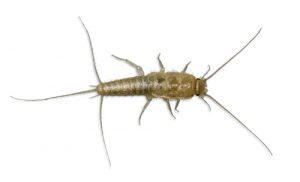
Firebrats are the same size and shape as silverfish: flattened, elongate, and carrot-shaped with long antennae and 3 bristletails at the rear, about 1/2 inch long (not including the antennae and tails). The two insects differ, however, in coloration. Silverfish are solid color, silvery to gray. Firebrats are tan to brown mottled with gray, and darker than silverfish. Young firebrats look like the adults, only smaller. Both firebrats and silverfish have habits that are similar to cockroaches. They are active at night, hiding in cracks during the day, and they can run rapidly. They don’t have wings.
 Often the first indication of a firebrat infestation is when a resident finds characteristic damage on wallpaper, books, photos, artwork, fabrics, or paper products in storage. Firebrats’ feeding can remove the surface glaze from papers or leave irregular, notched holes in paper or fabric. Their body scales and droppings can leave yellowish stains on paper and fabric. Silverfish cause the same kind of damage, so in the absence of an actual insect specimen, it’s the location that will give clues as to whether the culprits are silverfish or firebrats.
Firebrats like it hot. Very hot. They do poorly at temperatures that we think are comfortable. Their eggs will not hatch in temperatures below 75°F. Even at 85°, firebats develop slowly. Anything above 90° is acceptable, but they breed and survive best at temperatures between 98° and 102°F. Both nymphs and adult firebrats can survive temperatures up to 112°. Their “feet” are so heat-resistant that they can walk on top of furnaces, hot water pipes, and boilers. In addition to hot, firebrats like sites that are humid and dark.
This need for very high temperatures tells you a few things about firebrats as pests. First, they’re not going to present much of a problem in our area in the winter…except in commercial accounts. Unlike cockroaches, or even silverfish, you won’t find firebrats just anywhere in a home or business. They will be where the temperatures are high — around ovens, furnaces, baseboard heaters, fireplaces, hot water pipes, steam pipes, and in boiler rooms and hot attics. Firebrats can move throughout a building by following pipelines and will move to warmer areas within the building seasonally. In an infested hot attic or hot storage area, firebrats can be hiding in nearly any box, bag, or piece of furniture. Firebrats can become very serious pests in commercial sites that combine high heat with the availability of starchy foods, such as bakeries and commercial kitchens.
You can help control firebrats by reducing clutter, cleaning up spilled food, and reducing moisture. Remove old stacks of newspapers, magazines, paper, books, and fabrics, especially in attics and garages. Reducing humidity with dehumidifiers and fans can help. Likewise, lighting a darkened, sheltered area can help force firebrats into the open where they can be more easily controlled. In general, firebrat control is similar to cockroach control. But the fact that firebrats are found in such hot locations makes them a bit of a challenge to control since most insecticides break down more quickly at high temperatures.
If you have either a firebrat or silverfish problem, give Colonial a call. Our trained pest control technicians will perform a full inspection and design a pest management program to suit your needs and your specific pest problem. We do pests so you don’t have to!