Call For a Free Quote: 1.800.525.8084

Bird Control & Bird-Proofing Services in Massachusetts & New Hampshire


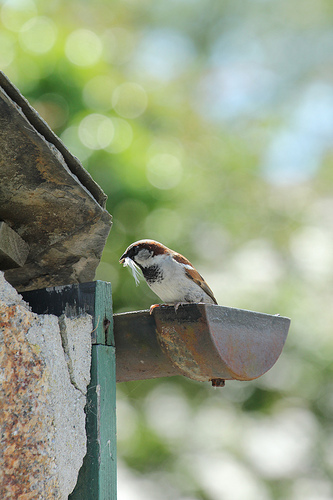
House Sparrow
Sparrow

Rock Dove
Pigeon

Starling
Starling


We specialize in Bird-Proofing commercial structures.

Most birds that we see in our yards and attract to our bird feeders are protected by federal law and cannot be killed, captured, or disturbed. There are three birds, however, that have attained special pest status and may be controlled under certain circumstances. Those three birds – the house sparrow, the feral pigeon, and the starling - are very familiar to most of us. All three have learned to coexist with people.

Many people do not see these birds as pests. But they become pests when they interfere with our health and welfare. House sparrows, pigeons, and starlings all like to nest on and in buildings, sometimes in large numbers. Accumulations of droppings can deface and damage surfaces, spread disease, and can attract flies and other insects. Nests can be the source of ectoparasites like mites and ticks that can bite people.

Pest birds displace native and more preferred birds and sometimes even take over their nests and kill their young. Pest birds have learned to beg for food around parks and to steal food from dumpsters and trash cans, scattering trash. Sparrow nests can block air conditioners and vents, causing fire hazards. Pigeons roost on historic buildings and statues, damaging surfaces and fouling sidewalks with their droppings. Starlings roost by the thousands in neighborhood trees, damaging cars and houses with their acidic droppings and creating a disturbance with their noise.

Pest birds can be managed in several different ways, depending on the type of bird and the circumstance. Bird-proofing is where we start. The logic is simple and the results are permanent. Make the environment undesirable as a nesting or roosting site and the birds will move on. Colonial’s bird-proofing services are designed for the specific pest bird and your property and may involve sealing up potential nest site openings, screening vents, or recommending structural modifications.

As part of our long-term solution for your problem, we can install netting for large areas, bird wire to keep birds from landing on ledges, beams, or balcony railings, or use scare tactics or trapping. Call Colonial and have our bird control experts recommend the best solution for your situation. We have more than 25 years experience in dealing with pest birds and we are fully certified and licensed by the states of MA and NH to perform bird-proofing and bird management.

The house sparrow is familiar to everyone. It depends on people for food and nesting sites. It likes to build its nest on buildings in any available opening or crevice such as on light fixtures, behind signs, under eaves, in rain gutters, and in electrical transformers. The nest is rather large and flimsy and is made from straw, grass, feathers, string, and other debris (some highly flammable!). Adult sparrows choose one mate for the season and raise as many as 4 clutches, each with about 5 eggs, before the end of the summer. House sparrows don’t migrate, but congregate in small flocks during the winter, feeding and roosting together. House sparrows are aggressive, territorial, and determined and frequently drive out desirable birds.

The pigeon (sometimes called the rock dove) nests on rocky cliffs in its native Europe and Asia. In U.S. cities, it has found its own version of rocky cliffs in the form of building ledges and manmade structures. In addition to building ledges, pigeons nest and roost on roofs, eaves, in attics, on steeples, under bridges or overpasses, and on signs or decorative areas on buildings. Pigeons are the most serious pest bird associated with buildings. Their presence greatly increases the cost of building maintenance. A pigeon’s nest is a messy, frail platform of small twigs, straw and debris that is often reused. There are at least two broods a year (of two eggs each), one in early summer and one in fall. Pigeons prefer flat and smooth surfaces for resting and feeding and feed mostly on the ground in parks, near food loading docks, grain spillage, garbage areas, or wherever people eat outdoors.

European starlings are known for their noisy flocking behavior which can mean tens of thousands of birds roosting in city parks or neighborhood trees. In urban areas, starlings like to nest in building cavities like chimneys, or kitchen, bathroom, or dryer vents. In suburban and rural areas, starlings nest in tree holes, birdhouses, and other openings. Nests are made of twigs, grass, and debris, lined with soft materials. There are usually two broods a year. While starlings roost in urban areas, they generally do not feed there. At dawn, starlings leave their roosting sites and may fly some distance to their feeding sites, often agricultural fields. They return at dusk, often noisily settling for a time on telephone wires, bridges, buildings, or in trees before settling in for the evening. The noise and the droppings from large numbers of birds is an annoyance and a health hazard for anyone unfortunate enough to live near a starling roost.

Colonial Pest Control has more than 25 years experience in dealing with pest birds and we are fully certified and licensed by the states of MA and NH to perform bird-proofing and bird management

Please call today for a FREE ESTIMATE for Squirrel Removal at 1-800-525-8084 or make the request online at - REQUEST A QUOTE


What Our Customers Are Saying:

"Very courteous rep and work professionally completed."
-Pat (Lunenburg, MA)


Corporate Offices:

Worcester 32 Lake Ave WorcesterMA 01604-5823

1-800-525-8084               1-508-792-1906

Service Centers: Massachusetts

Boston 60 State Street, Ste 700 • Boston, MA 02109 • (617) 224-1516
Framingham 945 Concord Street • Framingham, MA 01701 • (508) 872-4420
Fitchburg 344 Main Street • Fitchburg, MA 01420 • (978) 342-4240
Andover 300 Brickstone Square, Ste 201 • Andover, MA 01810 • (617) 340-1001

Areas We Serve

MASSACHUSETTS
Middlesex County: Framingham, Natick, Sudbury, Ashland, Marlborough, Hudson MA, Hopkinton Holliston, Acton, Concord MA, Stow, Burlington, Cambridge, Newton, Lowell, Ayer, Groton, Pepperell, Westford
Worcester County: Westborough, Southborough, Northborough, Grafton, Shrewsbury, Boylston, West Boylston, Holden, Paxton, Leicester, Auburn, Princeton, Sterling, Clinton, Bolton, Fitchburg, Leominster, Lunenburg, Blackstone, Milford MA, Hopedale, Mendon
Norfolk County: Brookline, Needham, Dover MA, Bellingham, Medway, Franklin, Norfolk, Millis
Essex County: Andover MA, North Andover, Lawrence, Methuen, Haverhill, Boxford, Georgetown
Suffolk County: Boston, Chelsea, Revere, Winthrop

Service Centers: New Hampshire

Nashua 20 Trafalgar Square, Ste 423 • Nashua, NH 03063 • (603) 880-7900
Bedford 15 Constitution Drive, Ste 149 • Bedford, NH 03110 • (603) 472-1083
Portsmouth 155 Fleet St. • Portsmouth, NH 03801 • (603) 436-6000

E-Mail: Service Centers -
Write a review about us!

Copyright © 2010. Colonial Pest Control, Inc. All Rights Reserved.
Website by Best Rank | Site Map


NEW HAMPSHIRE
Rockingham County: Portsmouth, Rye, Greenland, Hampton, Seabrook, Stratham, Exeter, Newton NH, Atkinson, Salem NH, Windham, Derry, Londonderry, Candia, Auburn NH, Plaistow, Hampstead, Sandown
Merrimack County: Concord NH, Bow, Pembroke NH, Chichester, Loudon, Canterbury, Dunbarton, Hooksett
Strafford County: Dover NH, Somersworth, Rochester NH, Farmington, Barrington, Durham, Rollinsford
Hillsborough County: Nashua, Hollis, Milford NH, Merrimack, Litchfield, Hudson NH, Pelham, Manchester NH, Bedford NH, Goffstown, Hudson NH, New Boston